
For parents of kids aged 6–13
Stop being the screen-time villain.
You set the limit. You hold the line. You take the blame. Nothing to Negotiate is a 72-day family system that hands the ending to a rule your child agreed to, so there’s nothing left to fight about.
 Free bonus · only with the system1 month of the Shield Family app
- No cold turkey
- No lectures
- No app required
- Calm-Days Guarantee

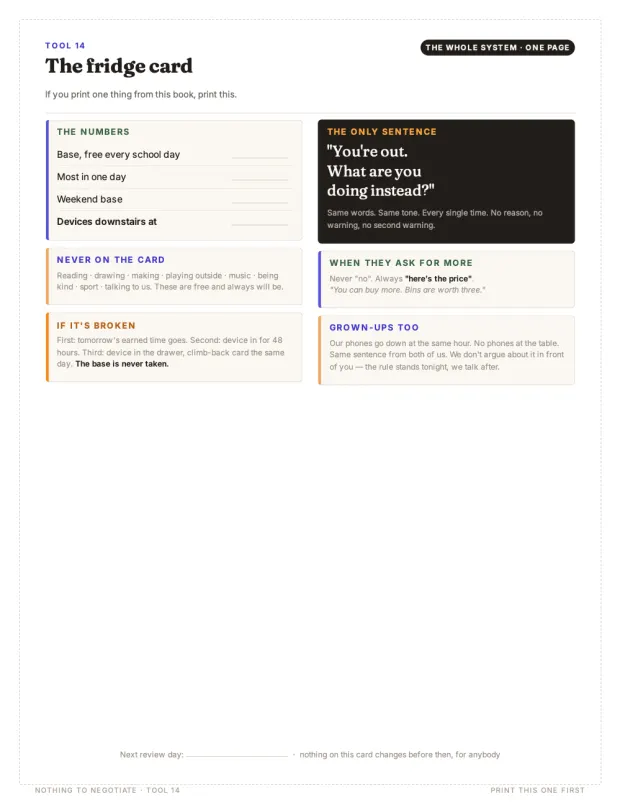
Example: 30 free minutes plus 15 earned for getting up and dressed. When the balance reaches zero, the only sentence is: you’re out, what are you doing instead?
4 files · 94 pages14 printable tools

1 month of the appFree
- 15 mintonight
- 50 minthis weekend, once
- 3 mina week after that
- 72 daysand then you stop
“The hardest part of screen time isn’t giving my child the phone — it’s ending it.”
“They forget to fill it in, we keep losing track of it.”
“If your partner doesn’t enforce those same rules, it is a losing battle.”
“We were just begging her to do these things to get the star.”
“Transition to nothing is always harder than transition to something.”
“I refuse to manhandle her to get them and don’t want to get into an altercation.”
“It makes the screentime seem like a super special thing.”
“The rule did it, not dad.”
Step 1The nightly fight
“Five more minutes.” Again.
It’s 8:52 on a school night. They heard “maybe”. Now you can hold the line and be the villain, or let it slide and teach them that asking works. Either way, you’ll be standing in the same doorway tomorrow.
0 of 8Tap the ones that happen in your house.
You’re not unusual. You’re unassisted.
Almost every house has the rule. Almost none has anything holding it up except a tired adult standing in a doorway. The fix isn’t more willpower. It’s giving the rule something else to stand on.
Pew Research Center, October 2025. The nine-in-ten figure comes from a single 2026 survey and is indicative.
What the arguing costs you
69 hours a yearspent in the doorway. The system asks for about two, once.
Step 2What nobody tells parents
It’s not your kid. And it’s not you.
We read the research and the parenting forums, and this is what held up. The opponent was never your child, or you. It’s a feed built to have no ending, and a rule that only holds while a tired adult stands in the doorway. Six things almost nobody explains to parents:
- 01
“Five more minutes” is a test, not a request.
They keep asking because one day you might say yes. Every time the limit moves after enough asking, your child learns that asking works. It isn’t defiance. It’s the cheapest option available, and it has worked before.
The researchIn daily diaries from 283 families, responding every single time predicted better behaviour, whatever the response was. Reliability beat strictness.
So the systemA number agreed in advance, on paper, that nobody changes before review day. Not you, and not them.
- 02
They’re not being difficult. They’re being nine.
Self-control is three separate skills, and the part of the brain that runs them isn’t finished until the mid-twenties. Before about seven, children judge time by how it feels, and they don’t count it on their own until about ten.
The researchAdele Diamond, University of British Columbia, 2013. Beatriz Luna, University of Pittsburgh, 245 people aged 8 to 30.
So the systemA balance they can see, so the room holds the rule instead of their willpower. Tokens for ages 6–9, minutes for 10–13.
- 03
The fight is about the ending, not the amount.
Ask parents what’s hardest and they don’t say how much. They say ending it. Your child is leaving something absorbing for what looks like nothing, and there’s a person standing there to negotiate with.
The researchAcross 380 real endings in 28 families, endings caused by the device, like an episode finishing, upset children less than a parent walking in. A modest difference, in children aged 1 to 5.
So the systemLet the rule, a timer or the phone do the ending, and always end into something they chose. Tonight, turn off autoplay: anything that rolls straight into the next thing makes stopping harder.
- 04
Taking the phone for a week makes it worse.
A week-long ban mostly builds resentment, and because a week is hard to hold, it often quietly collapses. That teaches the opposite of what you meant. With no written way back, there’s nothing to work towards either.
The researchA 2026 review of 42 studies and 12,957 children found a small but real benefit from deciding “if this happens, then that” in advance, strongest where self-control is weakest.
So the systemA three-rung ladder written before anything happens, measured in hours, never touching the free base, with a climb-back card that has dates on it.
- 05
It’s not how strict you are. It’s how you say it.
Having rules had almost nothing to do with rebellion. The delivery did. The same restriction, said bossily, produced the most resentment, and twelve-year-olds react worst of any age to being ordered.
The researchFour Ghent University studies of 1,472 young people. A University of Arizona study of 612 children aged about 9, 12 and 15.
So the systemSixteen prepared sentences that state the ending without giving anyone a reason to argue, plus a word-for-word script for the conversation that sets it up.
- 06
The app locked the iPad. Not the argument.
Children change the date, delete and reinstall, or borrow a friend’s phone. Settings are useful, because they take temptation out of an ordinary evening. But a limit nobody agreed to becomes a puzzle to solve.
The researchThree months after Australia’s under-16 social media ban, more than 85% of 408 adolescents were still on the restricted platforms. A review of 40 studies found little support for parental controls used on their own.
So the systemThe agreement comes first and names every route in advance. Anything done to get around it counts as breaking it, including ways nobody has thought of yet. Then the phone holds what your child already signed.
Agree the rule while everyone is calm. Let your child help write it. Let the rule end it, not you. Do those three things, and there is nothing left to negotiate.
Show me how that worksStep 3The one idea
Make the rule the bad guy.
- Not a ban
- Not a free-for-all
- Not spyware
Screen time should run out the way pocket money runs out. As arithmetic, not a verdict. Your child gets some free every day, earns more with boring jobs, and when it’s gone, it’s gone. Nobody decided anything, so there’s nobody to argue with.
- LimitA daily base that holds by itself
- EarnBoring jobs buy more minutes
- SpendIt runs out as arithmetic
- LandInto something they already chose
“When the time is up because they earned 30 minutes and the 30 minutes ran out, there’s nothing to negotiate. The rule did it, not dad.”
30min left today
- limit
- earn
- spend
- land
30 minutes arrive free every school day. Nobody has to earn those.
“You’re out. What are you doing instead?”
- Shoot hoops
- Build something
- Bake
- Walk the dog
The list was written by your child on Signing Night, so the answer already exists.



End into something, never into nothing. And never price what they already love: reading, drawing, sport and kindness stay free for life.
Step 4The words
Stop improvising at 9pm.
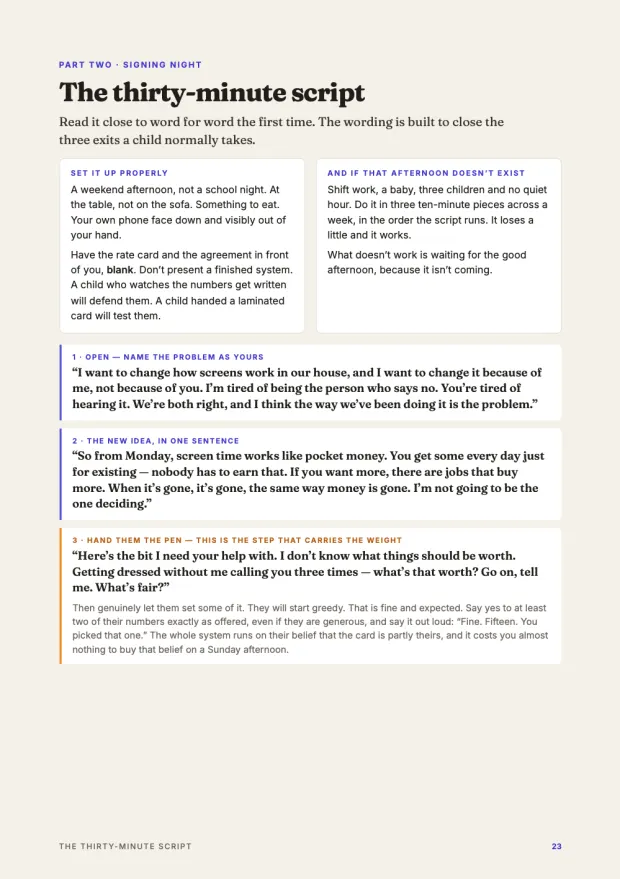
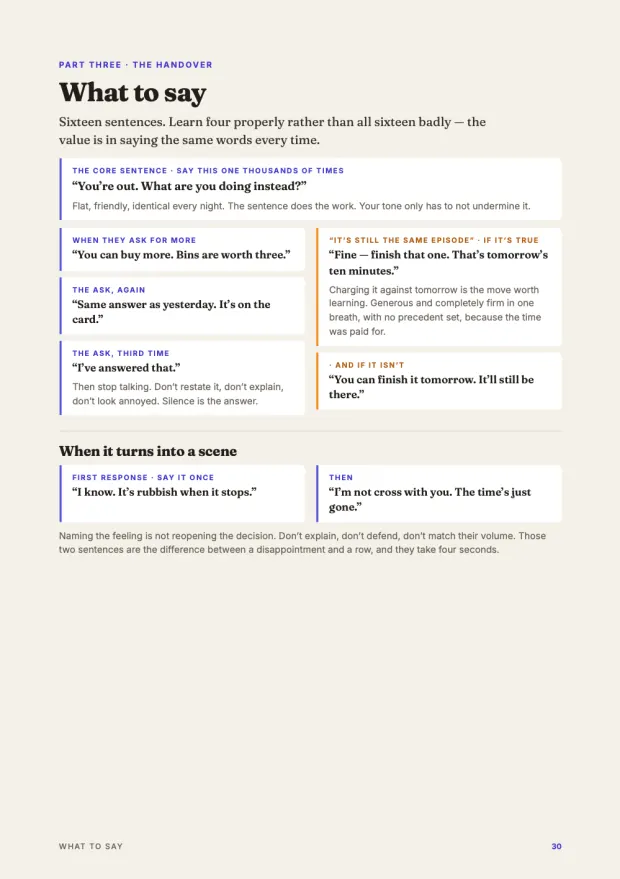
Not “be consistent”. The actual sentences. Sixteen of them for the ninety seconds when time is up, and a thirty-minute script for Signing Night. Same words every time, because variation invites negotiation.
Right, that’s your time. Give me the tablet. Now.
“You’re out. What are you doing instead?”
It states the ending without arguing for it, and hands them a decision at the exact moment they feel they have lost one.
Step 5Your first 72 days
Fifteen minutes tonight. That’s the start.
The 72-Day Plan tells you what to do and when, one card at a time. About two hours in total, spread over ten weeks. You never have to read ahead or plan anything.
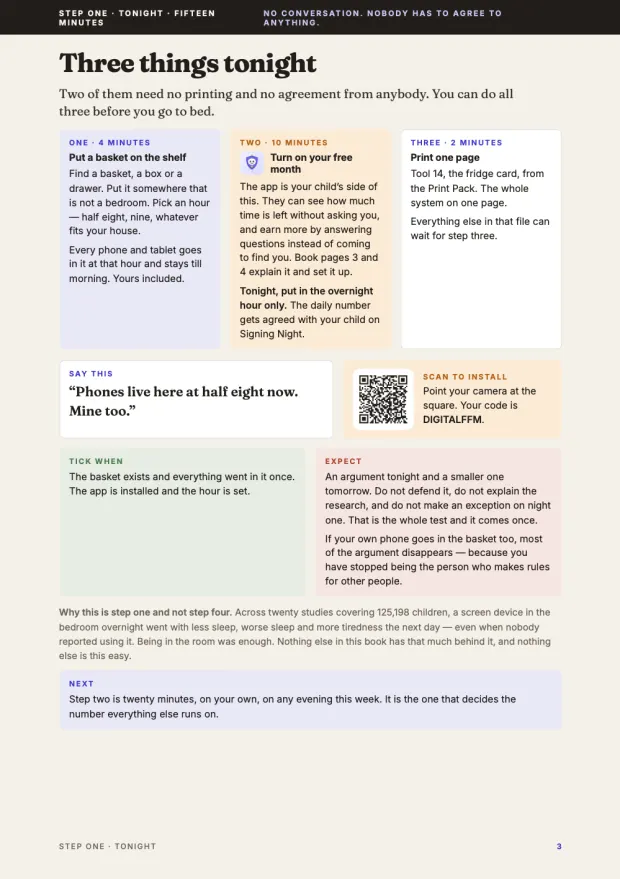
The 72-Day Plan, step one Tonight 15 minPut a basket on the shelf.
Pick an hour. Every phone and tablet goes in it and sleeps outside the bedroom, yours included. Print one page, the fridge card. No conversation, and nobody has to agree to anything.
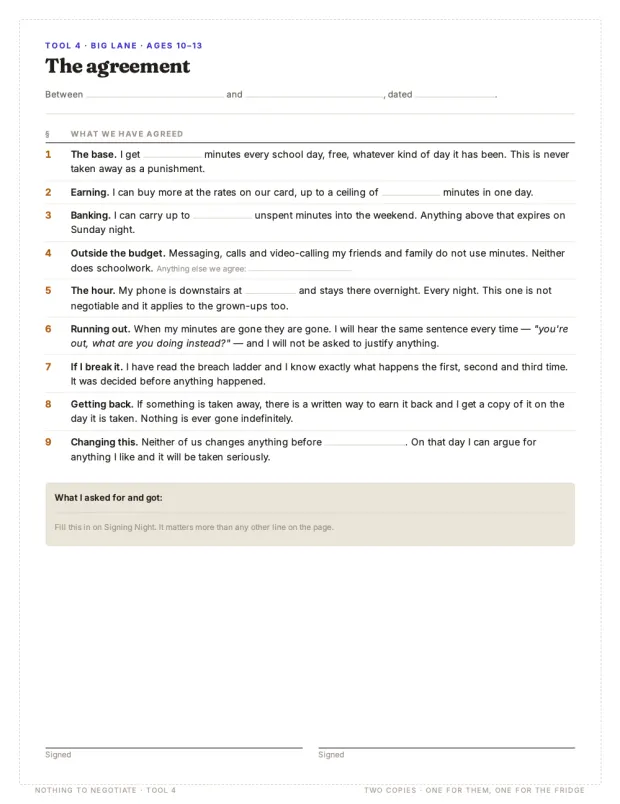
Tool 4, the agreement for ages 10–13 This weekend 50 minHold Signing Night.
Twenty minutes on your own to find your opening number. Then thirty at the table with your child, following the script close to word for word. They help set the prices. You both sign.
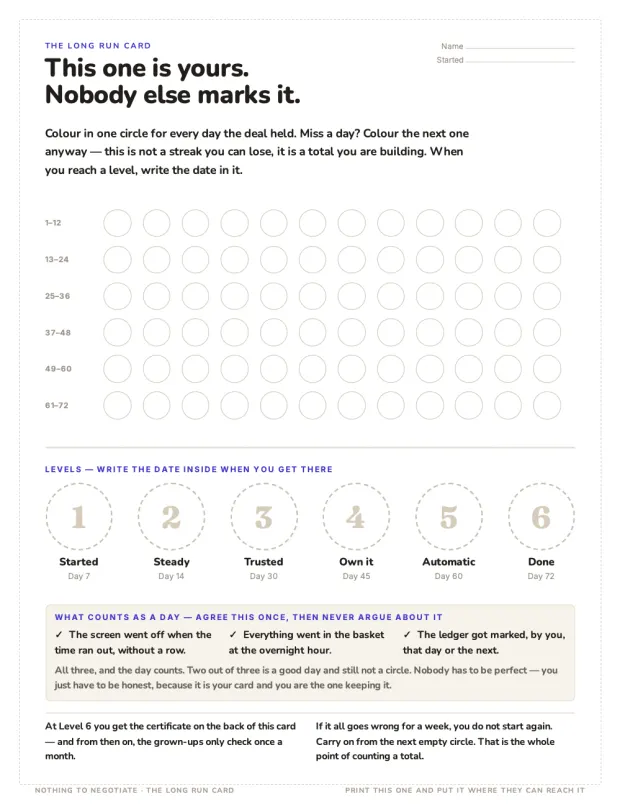
Your child’s Long Run Card After that 3 min a weekLet the rule carry it.
One look on a Sunday. The plan hands you one card a week, including the week it goes badly, until day 72, when you give your child the running of it and step back.
What the 72 days actually feel like
- Week 1The honeymoon
It goes surprisingly well. Change nothing.
- Week 2The test
The worst week, and it is expected.
- Week 3The quiet
The asking drops off. Not the wanting, the asking.
- Week 4The drift
Hold the hour. Run review day.
- Days 31–72Six Sundays
Hand over the ledger. Stop checking midweek.
- Day 72Hand it over
Sign the certificate. Check in monthly.
Tonight’s fifteen minutes are the easy part. Start there.
Get the system · $47The honest part
Week two gets worse. Don’t quit.
Around day eight the novelty wears off. A proper argument, a route around the rules, a bad Wednesday, and the moment you privately think this isn’t working. That’s where most systems get put down, about four days before they would have started working.
We tell you before it happens. The book has a page written to be read on that exact day, and it says: change nothing.
- Day 1: calm1
- Day 2: calm2
- Day 3: wobble3
- Day 4: calm4
- Day 5: calm5
- Day 6: wobble6
- Day 7: ladder used7
- Day 8: calm8
- Day 9: wobble9
- Day 10: wobble10
- Day 11: ladder used11
- Day 12: wobble12
- Day 13: calm13
- Day 14: wobble14
- Day 15: calm15
- Day 16: wobble16
- Day 17: calm17
- Day 18: calm18
- Day 19: wobble19
- Day 20: calm20
- Day 21: calm21
- Day 22: calm22
- Day 23: calm23
- Day 24: calm24
- Day 25: wobble25
- Day 26: calm26
- Day 27: calm27
- Day 28: calm28
- Day 29: calm29
- Day 30: calm30
If the last nine are calmer than the first nine, it worked, however week two felt. It’s also exactly how the guarantee works.

Let the phone say no for you.
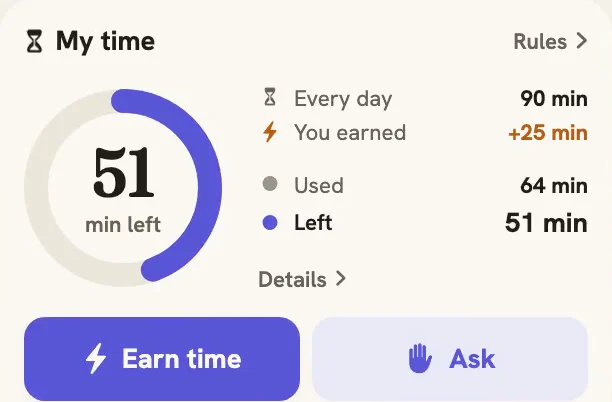
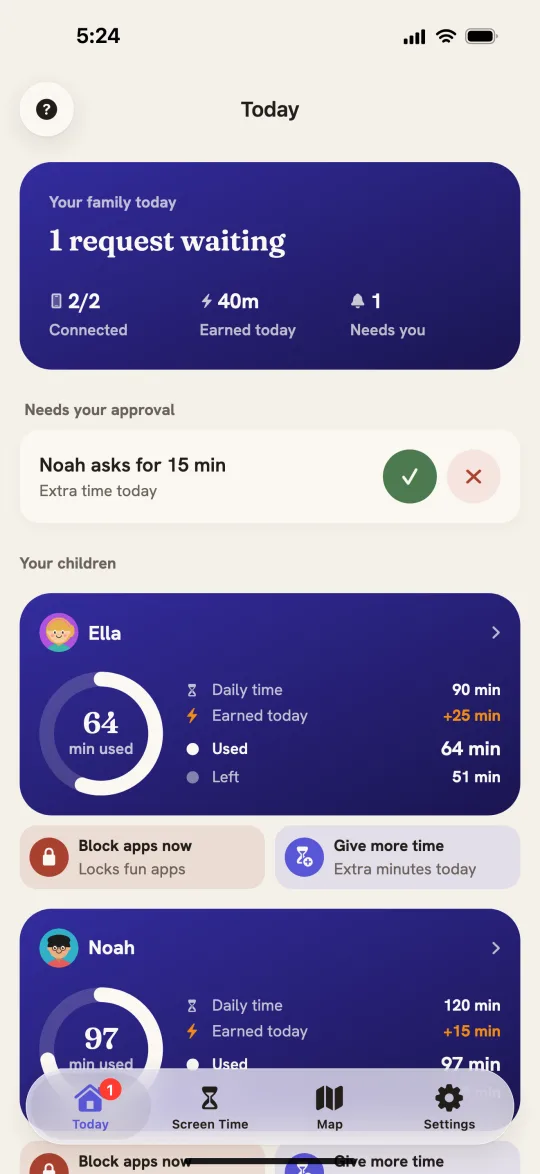
Shield Family is the app that runs the system. You see and change everything from your phone. The rules hold on theirs.
- Every child
See their day at a glance.
Minutes used, time earned and any request waiting for you, on one screen.
What else it does
- Say yes or no to “15 more minutes?” in one tap
- A feed of quizzes, games and arrivals
- The other parent sees the same family, on one plan
- Limits and blocking
Block apps in one tap.
A daily limit for the apps you choose, and a button that locks them right now.
What else it does
- Just games and social, or every app except the ones you keep open
- Bedtime and school time lock fun apps on schedule
- Adult websites blocked in every browser
- Calls, Messages and Maps always stay open
- Location
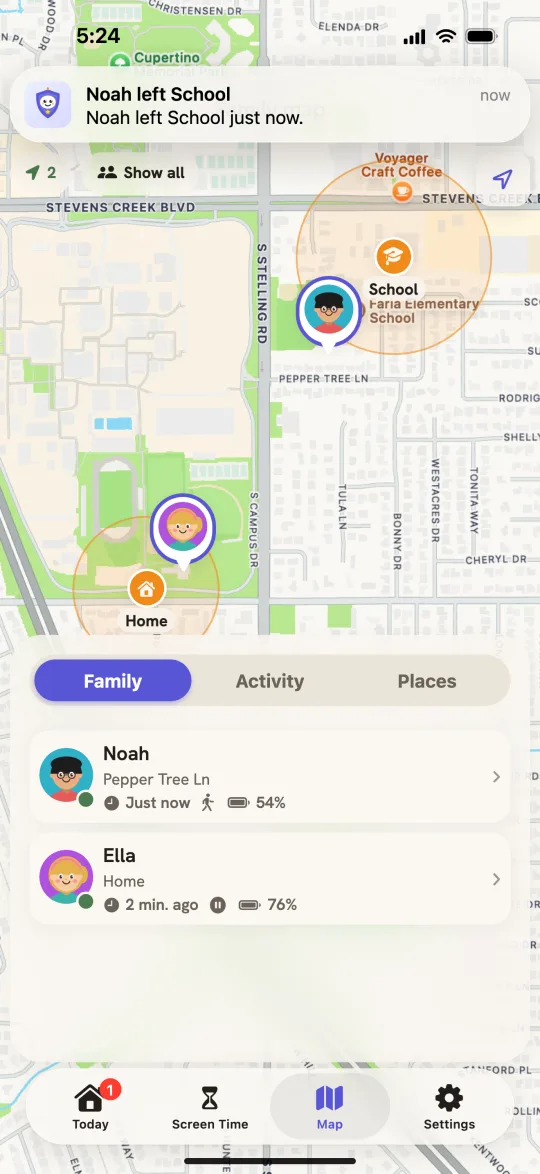
Know they got there.
A live family map, and an alert when they arrive at school or leave home.
What else it does
- Add Home or School once, for every child
- See where they’ve been today, and for how long
- Their battery level, so a quiet phone makes sense
- Learning
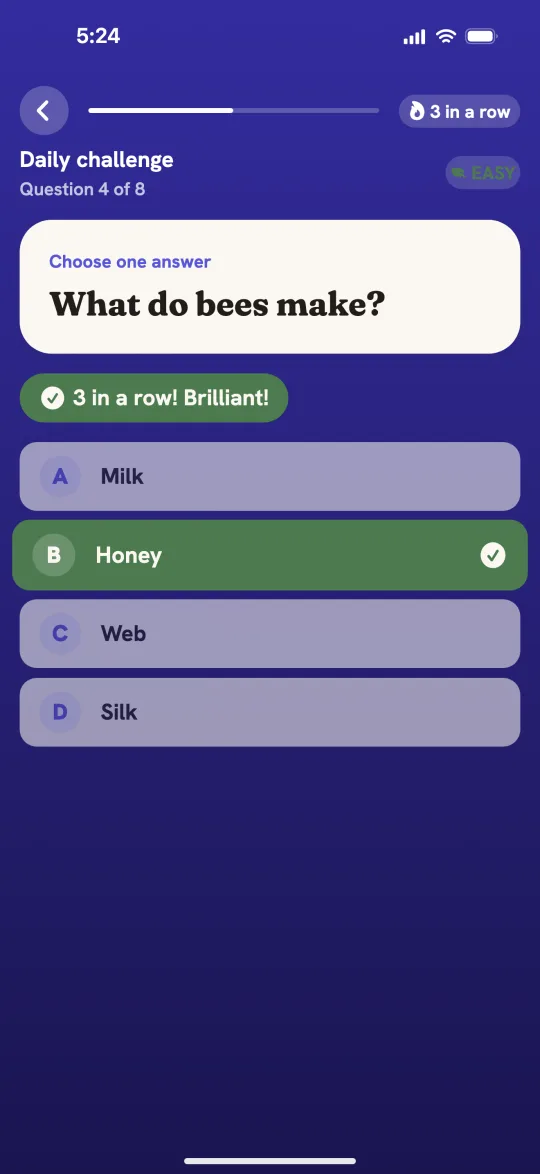
Extra time is earned by learning.
They answer real questions and play brain games to earn minutes, at a rate you set.
What else it does
- About fifteen subjects, from maths to money
- Questions match their age and come back until they stick
- You decide how many right answers buy a minute
How the free month works
- Buy the systemYour code is printed inside the download.
- Install Shield FamilyFrom the App Store, on your iPhone.
- Redeem your code“Redeem subscription code” during setup, or “Redeem code” in Settings.
 See it on the App StoreScan with your iPhone camera, or tapapps.apple.com
 What changes
Two months from now, nobody’s asking.
Not the wanting. The asking. This is what families who hold through week two describe, and what the plan walks you to.
- Around week three
They check the balance, not you.
The asking drops off. One evening you notice you haven’t had the argument in days.
- Day 30 · review day
A talk at the table, not a fight.
They make their case for more time. Saying yes on review day isn’t caving. It’s the point of it.
- Day 72
“This is yours now.”
You hand it over and check in once a month. The rule stands without you in the doorway.
“Five more minutes” at 8:52“You’re out. What are you doing instead?”The phone under the pillowEvery device in the basket by the overnight hourYou, the bad guyA rule they signed, doing the endingWondering if they got there“Noah arrived at School.”
Every family is different, and week two is still hard. That’s what the Calm-Days Guarantee is for.
Everything you get
The book, the tools and the app. One payment.
- 94pages, in 3 PDFs
- 14printable tools
- 16ready sentences for the hard moments
- 28parent questions answered
- 28named studies behind it
- 1month of the app, free
 File one · 13 pages
The 72-Day Plan
Open this first. Seven dated steps: what to do tonight, this weekend, and on six Sundays after.
Solves: not knowing where to start File two · 55 pages
Nothing to Negotiate, the book
The word-for-word scripts, both age lanes, 28 real parent questions answered, and every number sourced.
Solves: not knowing what to say File three · 26 pages
The Print Pack
All 14 tools: rate card, agreements, breach ladder, climb-back card, ledgers and the fridge card. Plus the Ten-Minute Box and your child’s Long Run Card.
Solves: rules that only live in your head File four · spreadsheet
The Rate Card Calculator
Finds your opening number, so you don’t set it too tight and lose week one.
Solves: guessing the number- Plus, free with your purchase
- Free bonus · only with the system
One full month of Shield Family
The same plan on your child’s iPhone: the rate card, the ladder and the 72 days, with a second way to earn time by learning. Your code is inside the download.
Solves: being the one who ends it$12.99Free - Bonus · yearly revisions
The next two editions, free
Device settings change every autumn. The book is revised each year, and the next two revisions arrive at your email.
Solves: advice going out of date
Inside the box
Exactly what you get. File by file.
No mystery bundle. Every step, chapter, tool and tab, with real pages from the files. Downloaded instantly from Whop the moment you buy.
File one · PDF · 13 pages · open this first
The 72-Day Plan
The whole system as seven dated steps, one card at a time, so you never read ahead or plan anything. Every card tells you what to do, what to say, when to tick it off, and what to expect.
- Format
- PDF, on any phone, tablet or computer
- Your time
- About two hours across ten weeks
- Starts
- Tonight, with fifteen minutes
The seven steps
- Tonight · 15 minA basket on the shelf, the overnight hour, and one page to print. No conversation needed.
- One evening this week · 20 minWork out your opening number, on your own, in pencil.
- Signing Night · 30 minThe conversation with your child, at the table, and both signatures.
- Days 1–30 · 3 min a weekRun it and change nothing, including the week that goes badly.
- Sunday oneDecide about the app, out loud, so it isn’t decided by accident.
- Sundays two to fiveHand over the ledger, stop checking midweek, take one job off the card, move the numbers once.
- Sunday six · Day 72Hand it over and step back. Plus the four-minute restart for the holiday that knocks it off course.
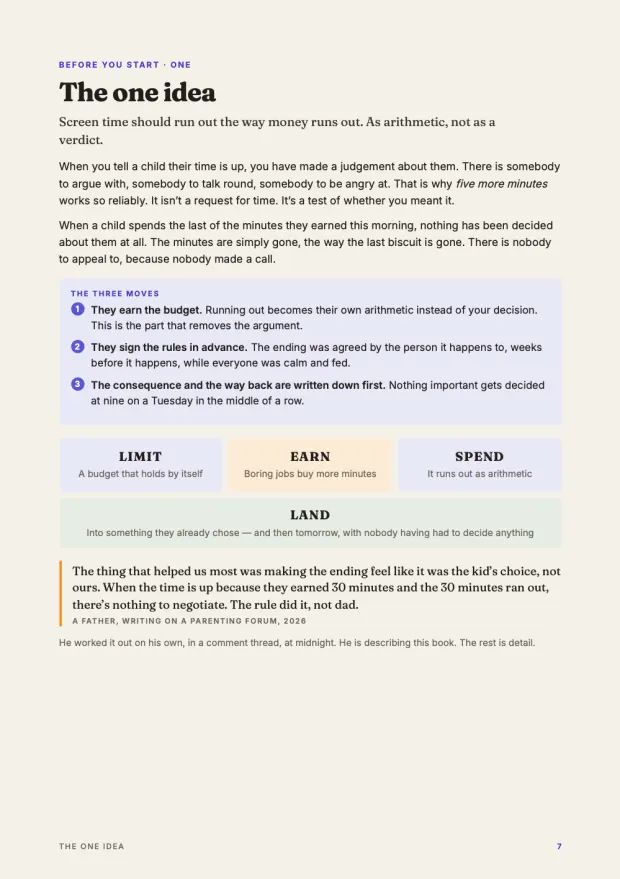
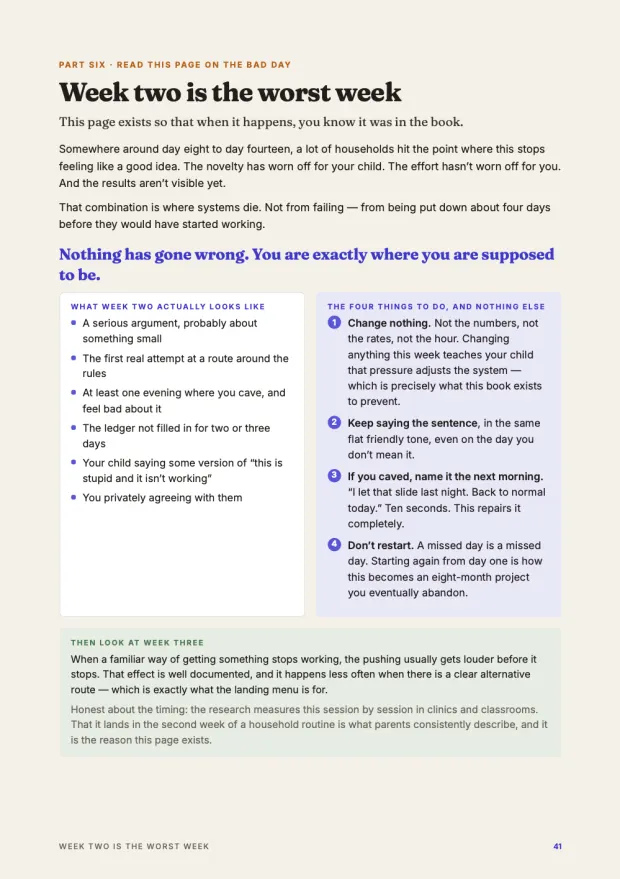
File two · PDF · 55 pages
Nothing to Negotiate
The why, and every situation answered. A manual, not a novel: read the short section before you start, then open the rest on the evening you actually need it.
- Format
- PDF with clickable contents
- Read before starting
- About 25 pages
- Sources
- Every number named, with its sample size
What each part covers
- Before you startThe one idea, which age lane your child is in, why they’re not being difficult, keeping the rule while changing the sentence, and “is my child addicted?”
- Part One · Set the rateWhy these systems fall apart, the golden rule, base, earn and ceiling, your opening number, and rate cards for ages 6–9 and 10–13.
- Part Two · Signing NightGetting the other adult on side, the thirty-minute script word for word, and the five things your child will say.
- Part Three · The handoverThe ninety seconds that decide it, games versus messages, ending into something, the script bank, and the hard ones: shops, work calls, grandparents, friends over.
- Part Four · The breach ladderDeciding the consequence in advance, the ways round it, and what to do when they won’t hand it over.
- Part Five · The climb-backHow to give it back, and the order things return in.
- Part Six · Thirty daysThe ledger that survives you, two homes, brothers and sisters, week by week, and week two.
- 28 questions parents askGetting started, ending it night after night, consequences and other people, and the worry underneath.
- At the backWhat to expect, six things you’ve been told about children, the full working graded, and where every number comes from.
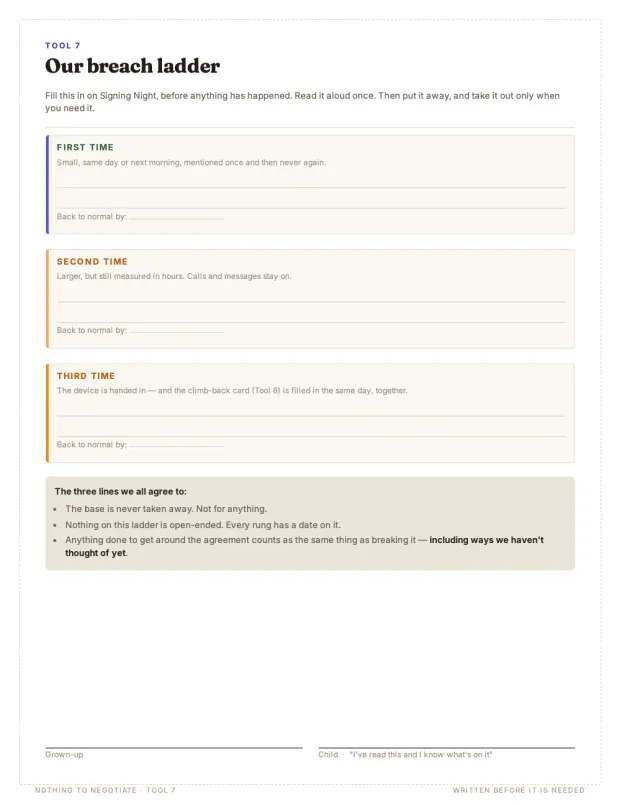
File three · PDF · 26 pages
The Print Pack
Everything that goes on a fridge, a wall or a table, in one file, so you never print the book. Designed for black and white on an ordinary home printer. Print three pages tonight; the plan tells you when you need the rest.
- Format
- PDF, black-and-white friendly
- Tools
- 14, plus six reusable sheets
- Two lanes
- Ages 6–9 and 10–13
All 14 tools, and two extras
- 1 · Our rate cardThe daily numbers, what buys time, and what is never for sale.
- 2 · The alignment sheetGrown-ups only. Both adults agree before the child is involved.
- 3 · Our screen dealThe six-line agreement for ages 6–9.
- 4 · The agreementNine clauses for ages 10–13, signed by both of you.
- 5 · My promiseThe grown-up’s half, signed at the same table.
- 6 · What I’m doing insteadYour child’s own list for when the screen stops.
- 7 · Our breach ladderFirst, second and third time, written before anything happens.
- 8 · The climb-back cardThe way back, with dates, filled in the same day.
- 9 · The weekA one-page ledger for ages 10–13.
- 10 · My token jarA colour-in ledger for ages 6–9.
- 11 · The thirty daysCalm, wobble or ladder. Three seconds a day.
- 12 · Review dayTwenty minutes at the table on day thirty.
- 13 · Between two housesThree things to agree, sent without a conversation.
- 14 · The fridge cardThe whole system on one page.
- The Ten-Minute BoxSix reusable folding, cutting and shape sheets for the ten minutes after a screen goes off.
- The Long Run CardYour child’s wall chart, with a certificate for day 72.
Your numbers · worked example
- Measured now, three-day average
- 90 min
- Opening share
- 70%
- Opening total
- 65 min
- Base share
- ⅔
- The base, free every school day
- 45 min
- A realistic day’s earning
- 20 min
- The ceiling, the most in one day
- 90 min
File four · Excel spreadsheet (.xlsx)
The Rate Card Calculator
Setting the first number too low is the most common reason a system dies in week one. Type into the yellow cells and it works out an opening number your child will accept, then checks your rate card can actually deliver it.
- Format
- Opens in Excel, Numbers or Google Sheets
- Your time
- About five minutes
- Optional
- The book shows the maths by hand too
The four tabs
- Start hereHow to use it, in four short steps.
- Your numbersMeasure three ordinary days, open at 70%, split two to one, set the ceiling. Plus school-day, weekend and holiday settings.
- Rate card checkList the jobs you plan to pay for and see whether the card can really deliver the earning your plan assumes.
- Worked exampleThe example from the book, filled in, so you can see the shape.
Free bonus · one month · only with the system
Shield Family
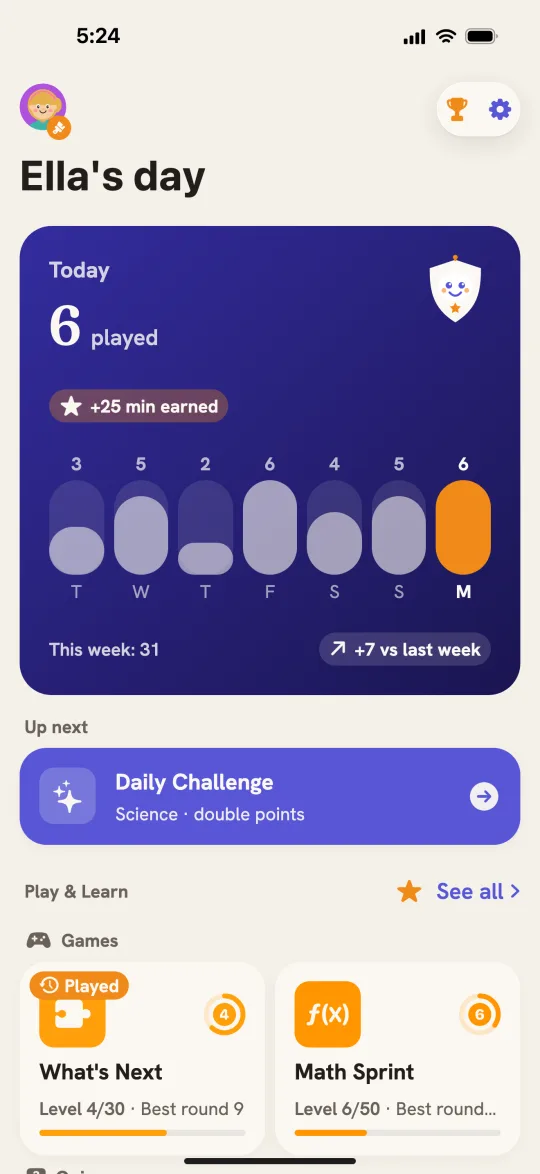
The system’s own app. Its Family plan screen holds your rate card, agreement, breach ladder and landing plan, and counts the 72 days with you. Your free-month code is printed inside the download; nothing in the book depends on the app.
- How you get it
- A code inside the download, redeemed in the app
- On its own
- 3-day trial, then $12.99 a month in the US
- Works on
- iPhone, iOS 26 or later
What the app does
- The Family planDaily base, can earn and ceiling, your grown-up promise and a review day, on one screen.
- If it’s brokenThe three rungs, written before anything happens. The daily base is never taken.
- What are you doing instead?The choices your child made while calm appear the moment their time runs out.
- The 72-day handoverMark each day calm, wobble or ladder used. A wobble never resets the count.
- Limits that holdA daily fun-time budget and an overnight hour, enforced by Apple Screen Time. Phone, Messages and Maps stay open.
- Earn by learningQuizzes and brain games across about fifteen school subjects, at a rate you set.
- One-tap requests“Can I have ten more?” arrives as a notification. Approve or decline.
- Safer webAdult sites blocked in every browser, plus your own always-blocked and always-allowed lists.
- Private by designNever reads messages, photos or browsing. No ads, no third-party tracking.
Plus the next two yearly editions of the book, sent to your email at no cost.
Get all of it · $47Before you decide
Built on research. Honest about its limits.
It’s for you if
- Your child is between 6 and 13.
- You already have a rule, but it only holds when you stand in the doorway.
- You want fewer arguments, not a perfect number of hours.
- You can find fifteen minutes tonight and fifty this weekend.
It’s not for you if
- You want an app to do the parenting. Software can hold a rule. It can’t make one.
- You want to be told how many hours is correct. There is no defensible number.
- Screens have pushed out school, friends, food or sleep for months. Please talk to your doctor first.
How much research sits behind each part
- Device out of the bedroom overnightStrong125,198 children
- Earned access, while the system runsStrong28 studies
- How the rule is said, not whether it existsStrong1,472 young people
- Applying it every single timeModerate77 programmes
- Deciding the consequence in advanceModerate12,957 children
- Writing it down and signing itModerate18 studies
The chore rates and landing into a chosen activity are the book’s own design, built on these findings rather than tested on their own. Every study is named in the book, so you can check any of it.
Questions
Still wondering?
The questions parents ask before they start. Something else on your mind? Email info@sarpoli.com and a person will answer.
Is this a subscription?
No. The toolkit is one payment of $47, and the files are yours to keep. The month of the app is a free bonus. Carrying on with the app afterwards is optional and separate.
My child is five, or fourteen. Is this for us?
It is built for ages 6 to 13. Under six, an earning system doesn’t work yet, but the chapter on endings does. From fourteen, earning reads as babyish and gets resented, while the breach ladder, the climb-back and your own promise still transfer whole.
What if my child refuses to sign?
It starts anyway, without drama: “You don’t have to sign it. It’s still how it works from Monday.” Leave the pen on the fridge. A surprising number sign within the week, once they see the review date is real.
My partner, or my ex, won’t back me up.
There is a grown-ups-only alignment sheet, and a one-page two-houses sheet you can send without a conversation. If the other adult won’t engage, run it as “how it works when you’re with me.” Half coverage works far better than none.
Isn’t paying children in screen time just bribery?
Only if you price the wrong things. The card prices routine jobs like getting dressed and the bins, never reading, drawing, sport or kindness. And some time arrives free every day, so screens stay ordinary.
We already use Screen Time or parental controls.
Keep them. Controls remove temptation, but they don’t make a rule, which is why the argument still happens. The system gives your controls something to enforce: a number your child agreed to.
Won’t they just find a way around it?
Probably, at some point. Changing the time zone, deleting and reinstalling, a borrowed phone: they’re all named in the agreement in advance, with one line that covers the rest. Anything done to get around it counts as breaking it, including ways nobody has thought of yet. A genuinely clever route earns a “that’s actually clever”, and then the ladder anyway.
What about homework and messaging friends?
Both sit outside the budget. Schoolwork never costs minutes, and from about ten, messages and calls with friends stay free too, because pricing them would mean pricing their friendships.
Can I just download the app instead?
You can, but the free month only comes with the system, because the code is printed inside the book. On its own, Shield Family is a 3-day trial, then $12.99 a month in the US. And the app alone does half the job: its Family plan screen can hold the numbers and the ladder, but the conversation at the table and the sentences are what end the argument.
How do I redeem the free month?
Your code is printed inside the download. Install Shield Family on your iPhone and tap “Redeem subscription code” on the subscription screen during setup, or “Redeem code” in Settings later. Apple’s own redemption sheet opens and the month starts straight away.
Do I need the app? We use Android.
No. Every tool works on paper, and that is the real product. Shield Family is iPhone-only, so Android families run the paper version, which does the same job.
What happens after the free month of the app?
The plan gives you that decision on its own card, so it isn’t made by accident. Keep the app at its regular App Store price ($12.99 a month in the US; prices vary by region), or stop and carry on with paper. Apple handles the subscription, and you can cancel any time in your Apple account settings.
How does the Calm-Days Guarantee work?
Run the system for 30 days and mark the thirty-days sheet, three seconds a night. If your last nine days aren’t calmer than your first nine, email info@sarpoli.com a photo of the sheet within 60 days of purchase and you’ll get a full refund. Keep the files.
Is my child addicted?
Almost certainly not. There is no diagnosis called screen addiction. What most families have is a normally developing child and a product engineered to have no ending, which a rule can solve. If gaming or scrolling has pushed out school, friends, food or sleep for months, talk to your doctor first.
Tonight can go differently.
From screen-time police to the family with a plan. You haven’t left this too late: six to thirteen is the window, and you’re in it.

8:52. “Five more minutes.” You in the doorway again, tired, deciding, and about to be the villain.

Screens are ordinary again. When the balance runs out: “You’re out. What are you doing instead?” Nobody has to be the villain.
- Instant download
- Calm-Days Guarantee
 A free month of the Shield Family app